

The integration of virtual reality into STEM education represents more than just a technological shift—it demands a fundamental rethinking of pedagogical approaches, classroom dynamics, and assessment strategies. As institutions like Prairie View A&M University pioneer VR-based algebra instruction through initiatives like Algeverse, faculty members find themselves navigating uncharted territory in mathematics education. Their experiences reveal both the transformative potential and practical challenges of implementing immersive technologies in collegiate STEM curricula.
Traditional mathematics instruction has long relied on a familiar formula: lecture-based delivery of concepts followed by problem-solving practice. This model, while entrenched in higher education, often struggles to address diverse learning needs, particularly in gateway courses like College Algebra where failure rates remain persistently high. Virtual reality disrupts this paradigm by creating active, experiential learning environments where students manipulate mathematical concepts in three-dimensional space. For professors accustomed to whiteboards and textbooks, this shift requires more than just learning new software—it necessitates reimagining their role in the learning process.
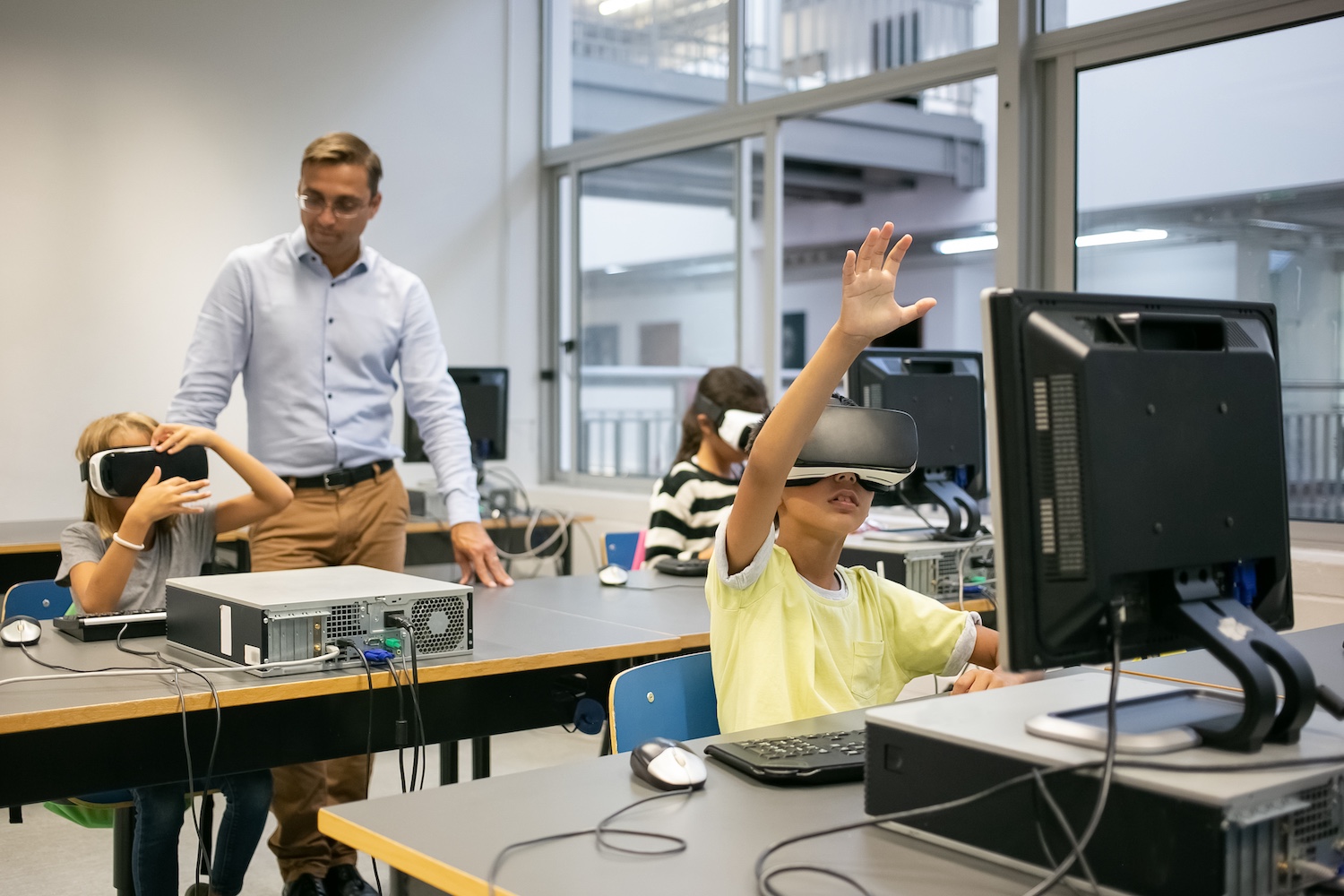
Early adopters of VR math instruction report a significant adjustment period. Where they once stood at the front of the classroom delivering content, they now find themselves facilitating exploration. The change from “sage on the stage” to “guide on the side” proves challenging for many educators deeply familiar with traditional methods. Some describe initial discomfort with the reduced emphasis on direct instruction, while others express concern about maintaining academic rigor in what might appear to be a game-like environment. These apprehensions often give way to surprise when they observe students engaging with mathematical concepts at deeper levels than typically seen in conventional classrooms.
The practical aspects of VR implementation present their own learning curve. Faculty must become proficient not only with the hardware—headsets, controllers, and tracking systems—but also with interpreting new forms of student data. Immersive environments generate rich analytics about learner behavior: time spent on specific concepts, patterns of interaction with virtual objects, even eye-tracking information that reveals attention and comprehension. Professors trained to assess understanding through tests and homework must now learn to read these alternative metrics, integrating them with traditional assessment methods to form a more complete picture of student learning.
Professional development emerges as a critical factor in successful VR integration. Effective training goes beyond technical tutorials to address pedagogical philosophy. Workshops for Algeverse instructors focus on designing effective VR learning experiences, balancing structured guidance with open exploration, and facilitating meaningful debrief sessions after immersive activities. This training emphasizes that VR doesn’t eliminate the professor’s role but transforms it—from content deliverer to learning architect and facilitator.
Assessment strategies evolve alongside teaching methods. Traditional algebra assessments emphasizing procedural fluency and correct answers give way to more nuanced evaluations that consider problem-solving approaches, persistence, and the ability to transfer concepts between representations. Some faculty develop rubrics that assess how students navigate virtual environments, while others create hybrid assessments combining VR activities with written explanations. This shift challenges long-held assumptions about what constitutes mathematical proficiency and how best to measure it.
The classroom dynamic undergoes subtle but important changes in VR-enhanced courses. Professors describe a noticeable shift in student engagement, particularly among those who typically struggle in traditional settings. The immersive nature of VR appears to lower affective filters, with previously quiet students becoming more willing to experiment and take risks. Educators also report changing patterns of interaction—rather than waiting for instructors to notice raised hands, students in VR often work through challenges independently before seeking targeted help. This fosters more efficient use of faculty expertise, with professors spending less time on routine clarification and more on conceptual development.
Accessibility considerations take on new dimensions in virtual learning environments. Faculty collaborate with disability services to ensure VR experiences accommodate diverse needs, from adjusting controller sensitivity for students with motor impairments to implementing audio descriptions for visually impaired learners. These efforts reveal both the challenges and opportunities of immersive technology—while some accommodations require creative problem-solving, VR also offers novel ways to make mathematical concepts accessible that aren’t possible in traditional formats.
The time investment required for effective VR implementation emerges as a consistent theme. Developing high-quality VR curriculum materials demands significant upfront effort, from storyboarding interactive scenarios to aligning virtual activities with learning objectives. Many professors describe spending more time on course preparation initially, though they note this decreases as they build experience and resource libraries. The logistical aspects of managing VR equipment also add new responsibilities, from troubleshooting technical issues to scheduling headset use among students.
Despite these challenges, faculty report powerful rewards. Many describe the satisfaction of seeing “lightbulb moments” occur more frequently and across a broader range of students. Others value the opportunity to innovate in their teaching after years of using the same methods. Several note improved student retention in STEM majors after the algebra hurdle, suggesting that VR instruction may have ripple effects throughout academic pathways.
The broader implications for STEM education continue to unfold. As more faculty gain experience with immersive technologies, they contribute to a growing knowledge base about effective practices. Their insights inform not only VR implementation but also traditional teaching, as strategies developed in virtual environments—emphasis on exploration, multiple representations, and productive struggle—find their way back into conventional classrooms.
This transition to VR-enhanced instruction doesn’t represent a rejection of traditional teaching expertise but rather an expansion of it. The most successful implementations marry technological innovation with deep pedagogical knowledge, leveraging what professors already know about how students learn mathematics while opening new possibilities for engagement and understanding. As the technology matures and more faculty gain experience, a new model of STEM education is emerging—one that combines the best of human teaching with the unique capabilities of immersive learning environments.
The journey isn’t without its difficulties, but for professors willing to embrace the challenge, teaching math in virtual worlds offers an opportunity to reach students in ways that were previously impossible. Their experiences suggest that the future of STEM education may lie not in choosing between technology and tradition, but in finding the powerful synergies between them. As one longtime mathematics instructor reflected after her first semester using VR, “I’m teaching the same algebra I’ve taught for years, but my students are learning it in ways I never imagined.” That gap between teaching and learning—and the potential to bridge it through thoughtful technology integration—lies at the heart of the VR revolution in STEM education.